

My name is Noella Ngunyam. I was born and raised in Cameroon, in a community stricken by poverty. As a young girl, I faced many challenges, often lacking basic necessities and experiencing emotional neglect. I believed life would become easier as I grew older, but instead I learned early what it truly means to grow up as an underprivileged young girl in Africa.
One of the most painful memories of my childhood is my first period. I was 14. In a community where menstruation and sexual and reproductive health are still taboo subjects, I had no guidance. Instead of receiving support, I was met with harsh words and punishment: “You have been playing with boys. You will bring pregnancy to the house.” That experience left me ashamed and confused about my own body and self-worth. It also marked the beginning of my experience with period poverty, often having to rely on rags and pieces of cloth because sanitary pads were simply unaffordable and never a household priority.
Through all this, books became my refuge. Education opened my eyes to possibilities beyond the limitations surrounding me. At 17, I became pregnant and was forced to drop out of school, navigating the realities of being a teenage mother. At 20, I entered a concubinage relationship, not out of choice but out of survival. Like many girls in underserved communities, I learned early what it means to trade safety for support and dreams for daily survival. Still, I refused to give up on my education and remained determined to build a better future for myself and for girls like me.
Once I completed my secondary studies, continuing my education was another struggle. Even after enrolling in university, I could not afford the yearly $100 tuition fee (50,000 FCFA). I worked menial jobs and sometimes skipped classes just to stay in school. In the process, I faced abuse and sexual violence and often went days without food or shelter while trying to gather school fees. These experiences made me realise how many girls see their dreams cut short each day because of poverty, limited access to education, cultural expectations, and conflict — a reality now affecting thousands of girls in Cameroon. Their stories are painfully similar to mine.


Determined to change this reality, I founded Girls HerRising, a grassroots feminist initiative dedicated to educating and empowering displaced girls and young women affected by Cameroon’s Anglophone crisis. Since 2016, armed conflict in the Northwest and Southwest regions of the country has severely disrupted education and livelihoods, displacing hundreds of thousands internally, with girls and young women among the hardest hit.
My goal is simple: no girl, especially one displaced by conflict or crisis, should be denied her right to education, dignity, and opportunity.

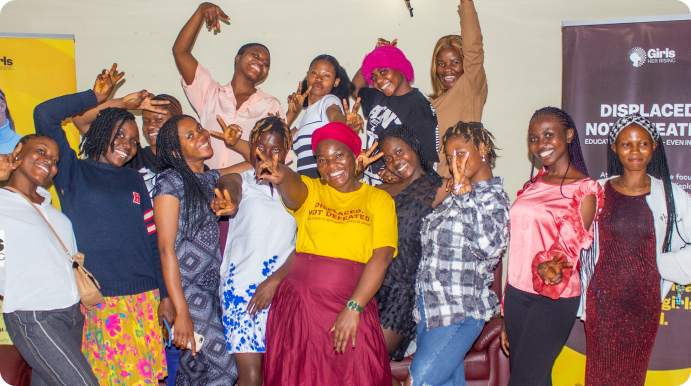
And for this, I have a bold ambition. By 2030, I aim to support 1,000 internally displaced girls and young women to re-enter school, continue their studies, and graduate from university. Each year, this translates into supporting 200 displaced girls and young women through academic scholarships, vocational training, and mentorship opportunities. I am hopeful that, as in my own case, education will become their gateway to reclaiming their futures despite the challenges of conflict, eventually helping them lift themselves and their families out of poverty.
This vision comes to life through the Evelyn Chuabe Scholarship and Mentorship Initiative, named after my adoptive mother, a teacher whose unwavering belief in education deeply influenced my own journey. Supporting these young women requires approximately $20,000 annually, covering not only tuition but also mentorship, digital access, livelihood support, psychosocial care, and practical skills that enable them to secure employment, start small businesses, and sustain their independence.
At the same time, our work addresses the structural barriers keeping girls out of school, including period poverty, which continues to cause absenteeism, shame, and dropout among millions of girls who lack safe menstrual products and facilities. We also create platforms where displaced girls and young women can share their experiences, advocate for themselves, and participate in conversations and decisions affecting their lives.
I am deeply committed to removing the barriers that trap displaced girls in cycles of early marriage, exploitation, poverty, and silence, so they are no longer defined by what they have lost but by what they dare to become: educated, empowered, and equipped to lead change within their communities and beyond. I am a living example of what education and opportunity can make possible, and I remain convinced that investing in girls and women is an investment in stronger, more just communities and a more equitable future.


Unlearning: Breaking Free A Transition from Lovelessness
All proceeds go to Girls HerRising for the education of displaced girls forced out of school by the Anglophone Crisis
Girls Her Rising is led by a diverse team united to protect the education, dignity, and leadership of displaced girls and young women.

Programs Advisor

Programs Officer-Education & Skills
Programs Officer-Dignity & Wellbeing

Programs Officer-Leadership & Agency

Communications Officer


We are the only organization in Cameroon dedicated exclusively to supporting internally displaced girls and young women affected by the Anglophone Crisis.
Get in touch with us
girlsherrising@gmail.com

+237672377935
Quick Links


Copyright @ 2025 Girls HerRising All Rights Reserved